Ask five different contractors which insulation is the best, and you will probably get five different answers, and honestly, all five of them might be right for the specific house they are picturing. Insulation is not a one size fits all decision. A 1920s home with balloon framing has different needs than a new construction build with a tight envelope, and a homeowner on a strict budget is going to weigh things differently than someone chasing the lowest possible energy bill for the next twenty years.
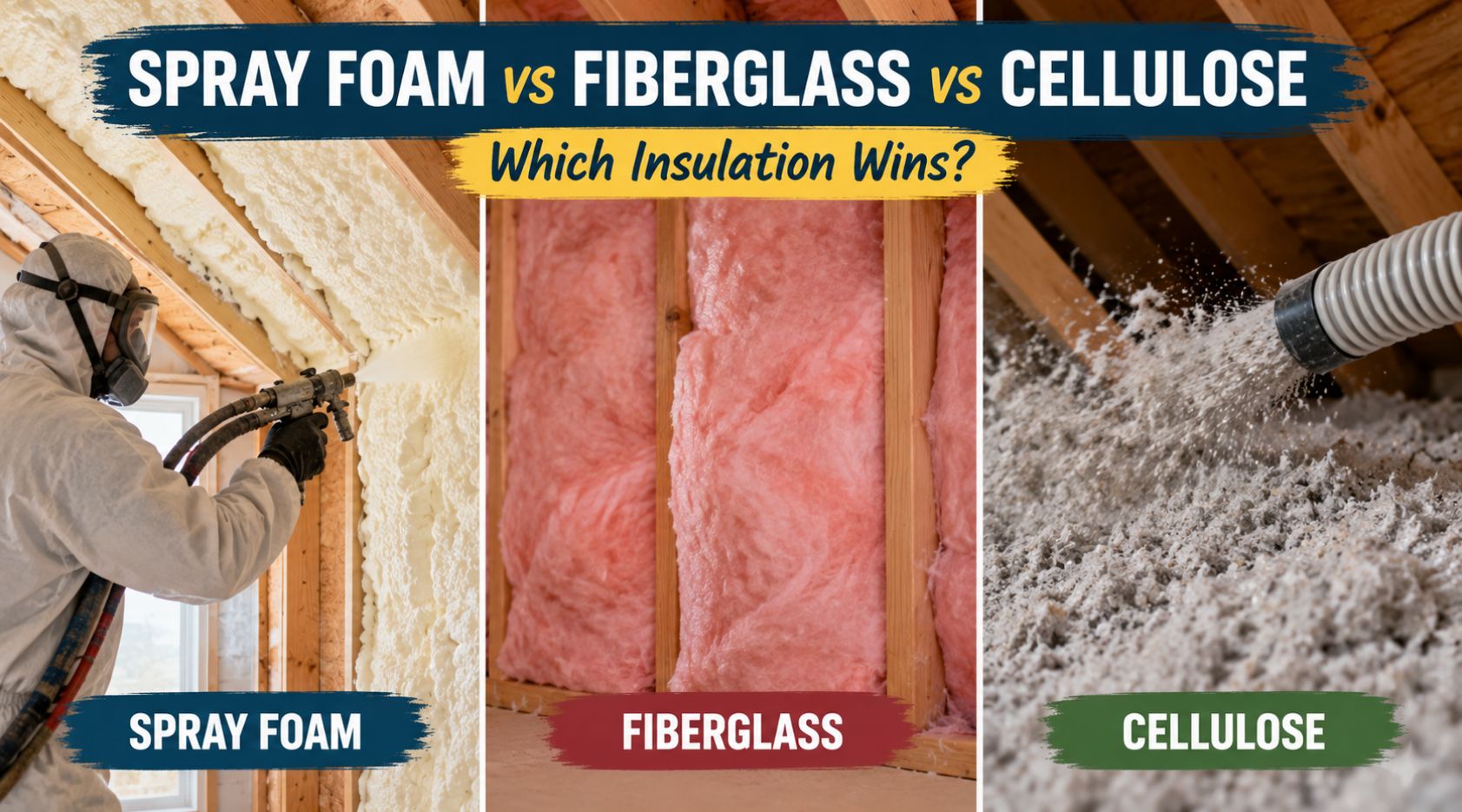
This guide breaks down the three most common options homeowners run into today, spray foam, fiberglass, and cellulose, and looks at how they actually stack up against each other on the things that matter most: cost, R-value, moisture handling, air sealing, longevity, and how disruptive the installation process is. By the end, you should have a much clearer sense of which one fits your situation rather than just which one has the best marketing.
A Quick Overview of Each Material
Fiberglass is the material most people picture when they think of insulation. It comes in batts or rolls, made of fine glass fibers, and it has been the standard choice in American homes for decades mainly because it is inexpensive and widely available. Loose fill fiberglass is also blown into attics using a machine, similar to how cellulose is installed.
Cellulose is made primarily from recycled paper, usually newspaper, treated with borate chemicals for fire resistance and pest control. It is blown in loose, most commonly into attics and sometimes into wall cavities in older homes during retrofits, and it has a reputation among energy auditors for doing a genuinely good job of filling irregular spaces.
Spray foam is the newest of the three and the one we cover most on this site. It comes in open cell and closed cell varieties, gets mixed and sprayed wet, then expands and cures into a solid, air sealing layer. We go into detail on the difference between the two types in our post on choosing between open cell and closed cell spray foam, which is worth reading if you have already decided foam is the direction you want to go and just need to pick a type.
Cost Comparison
This is usually the first question anyone asks, and it is also where the differences are the starkest. Fiberglass batts are the cheapest option per square foot, and blown-in fiberglass is close behind. Cellulose sits in a similar price range, sometimes slightly higher depending on your region and how much borate treatment is used.
Spray foam is the most expensive of the three, often by a wide margin, particularly closed cell foam. Material costs, the equipment needed to apply it, and the labor and training required to do it correctly all add up. We covered actual price ranges in more depth in our breakdown of what spray foam insulation costs, and the short version is that foam can run two to four times what fiberglass or cellulose would cost for the same square footage.
That said, cost per square foot is not the whole story, and the next few sections explain why.
R-Value and Actual Performance
R-value measures resistance to heat flow, and on paper, closed cell spray foam wins this comparison outright, often rated around R-6 to R-7 per inch, compared to roughly R-3.5 for fiberglass and cellulose per inch. Open cell foam sits in between, usually around R-3.5 to R-4 per inch, closer to the other two materials than to closed cell foam.
But R-value on a spec sheet only tells part of the story, because it assumes perfect installation with no gaps. Fiberglass batts are notorious for underperforming in the real world because they rely on a snug, gapless fit to hit their rated performance, and even small gaps or compression around wiring and outlets can meaningfully reduce effectiveness. Cellulose tends to perform closer to its rated value because the loose fill settles into odd shapes and gaps more naturally.
Spray foam, because it expands and fills every crack and crevice it touches, is the material least affected by this gap problem, which is a big part of why it often outperforms its raw R-value number would suggest in real world energy audits. We touched on how density affects this in our guide to spray foam density and R-values, which is useful if you want to understand why not all spray foam performs the same.
Air Sealing
This is where spray foam separates itself most clearly from the other two. Fiberglass and cellulose slow down heat transfer, but neither one stops air movement on its own. Air can still flow through gaps, around fixtures, and through the material itself to some degree, which is why both are typically paired with a separate air barrier in a well built home.
Spray foam is an insulator and an air barrier in one step. Once it cures, it seals the cavity it was sprayed into, blocking drafts and the air leakage that drives a lot of energy loss in older homes. This is one of the main reasons foam has become popular for rim joists and other notoriously leaky areas, a topic we get into in our post about common problem areas where foam gets used.
If your main issue is drafts, cold spots near outlets, or a house that just never feels quite sealed no matter how much you insulate, that is a strong signal pointing toward spray foam over the other two.
Moisture and Mold Resistance
Cellulose, being made from paper, can hold onto moisture if it gets wet, and if it stays wet for long enough, mold becomes a real risk. Fiberglass does not feed mold growth the way cellulose can, but it also does not stop moisture from moving through a wall assembly, and trapped moisture behind fiberglass batts is a common finding during home inspections.
Closed cell spray foam is largely resistant to water absorption and can actually act as a vapor barrier in the right applications. Open cell foam is more permeable and allows some moisture movement, which can actually be an advantage in certain climates where trapping moisture inside a wall would cause bigger problems.
It is worth being clear here that spray foam is not magic, and it does not make a house immune to mold. We wrote specifically about this in our article on why spray foam is not mold proof, because trapped moisture behind foam, especially from an undetected roof or plumbing leak, can still cause serious problems that are harder to spot because the foam is covering the evidence.
Installation Process and Disruption
Fiberglass batts are the easiest to install and the most DIY-friendly of the three, which is part of why they remain popular for smaller projects. Cellulose requires a blowing machine but is still relatively approachable for a motivated homeowner, though it does get messy.
Spray foam is a different category of job entirely. It requires trained applicators, proper safety equipment, controlled temperatures, and often means clearing occupants out of the space while it is sprayed and cured due to the fumes involved. We have written before about why DIY spray foam application tends to go wrong, in our piece on common DIY insulation mistakes, and the short version is that this is one job most homeowners are better off leaving to a professional crew.
Lifespan
Spray foam, when installed correctly, is generally considered to last the lifetime of the building, often quoted at 80 years or more without significant degradation. Fiberglass has a long lifespan too, often 80 to 100 years, but it does settle and can lose loft over time, particularly loose fill fiberglass. Cellulose settles more noticeably than either of the other two, sometimes losing 20 percent or more of its installed depth over the years, which reduces its effective R-value unless it is topped off.
So Which One Actually Wins?
There is no single winner here, and anyone who tells you otherwise is probably trying to sell you something. Fiberglass makes sense for budget-conscious projects, straightforward wall cavities, and situations where a homeowner wants to do the work themselves. Cellulose is a strong choice for attic retrofits in older homes, especially where sustainability and recycled content matter to the homeowner, and it does a solid job filling irregular attic spaces around trusses and wiring.
Spray foam wins when air sealing and long-term energy performance matter more than upfront cost, when the space being insulated is prone to drafts or moisture issues, or when a homeowner is planning to stay in the house long enough for the energy savings to offset the higher installation cost. It also tends to be the right call in tricky spaces like rim joists, cathedral ceilings, and additions where getting a tight, gap-free seal with batts or loose fill is genuinely difficult.
If you are still weighing the decision, it helps to think less about which material is objectively best and more about which problem you are actually trying to solve in your specific house.
Frequently Asked Questions
Is spray foam insulation worth the extra cost compared to fiberglass?
It depends on your goals and how long you plan to stay in the home. Spray foam typically costs more upfront but performs better as an air sealer and tends to hold its R-value over time better than fiberglass, which can make it worth it for homeowners focused on long-term energy savings rather than the lowest initial price.
Can spray foam and fiberglass be used together in the same house?
Yes, and this is actually common. Many homes use spray foam in hard to reach or leak-prone areas like rim joists and attics, while using fiberglass batts in simpler wall cavities where budget matters more and air sealing is less critical.
Does cellulose insulation attract pests or mold?
Cellulose is treated with borate, which resists both pests and mold under normal conditions. However, if it becomes wet and stays wet, the paper content can support mold growth, so moisture control matters more with cellulose than with closed cell spray foam.
Which insulation type is best for an attic?
Cellulose and open cell spray foam are both popular attic choices. Cellulose is more budget friendly and works well for a vented attic, while open cell foam is often chosen for unvented, conditioned attics where air sealing is a priority.
Does spray foam insulation lose R-value over time like fiberglass and cellulose can?
Properly installed spray foam is much more resistant to settling and degradation than either fiberglass or cellulose, and it generally maintains its R-value for the life of the building, whereas the other two can lose some effectiveness over time due to settling or compression.
Is fiberglass insulation still a good choice in 2026?
Yes, fiberglass remains a practical and affordable option, particularly for standard wall cavities and budget-conscious projects. It is not the best choice for air sealing on its own, but paired with proper air barrier work, it still performs well in most residential applications.
Free · No obligation
Get spray foam quotes from a local pro
Tell us what you want insulated and where. We’ll connect you with a qualified spray foam contractor near you.