Last updated: June 8, 2026 | Written by Diana Mills | Reviewed by Jennifer Nakamura
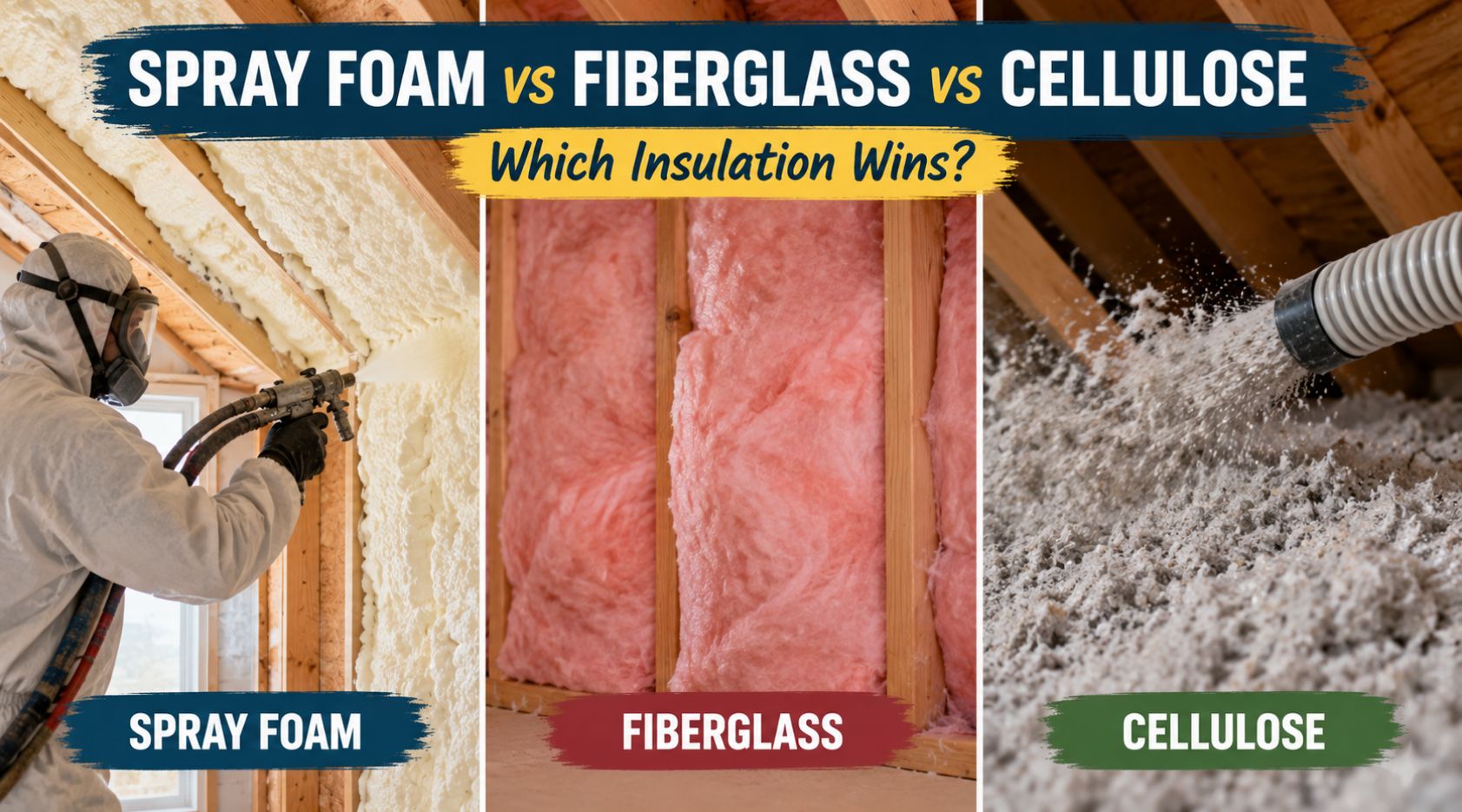
The spray foam vs. fiberglass debate has been going on for decades, and the honest answer isn’t as simple as most contractors or insulation salespeople want you to believe. Both materials have real strengths and real weaknesses, and the right choice depends on your specific project, budget, climate, and goals.
This guide gives you the complete, unbiased comparison — written by people who have seen both materials succeed and fail in the real world.
Quick Comparison Summary
| Factor | Spray Foam | Fiberglass Batts | Winner |
|---|---|---|---|
| R-Value per Inch | R-3.7 (open cell) / R-6.5 (closed cell) | R-3.1 to R-3.4 | Spray Foam |
| Air Sealing | Excellent – fills all gaps | None – requires separate air barrier | Spray Foam |
| Upfront Cost | $1.50–$4.00/sq ft installed | $0.30–$1.50/sq ft installed | Fiberglass |
| Moisture Resistance | Closed cell: excellent vapor barrier | Absorbs moisture, supports mold | Closed-Cell Spray Foam |
| DIY-Friendliness | Possible with kits, requires PPE | Easy – standard DIY project | Fiberglass |
| Longevity | 50+ years, no settling | 15–20 years, settles over time | Spray Foam |
| Structural Benefit | Closed-cell adds racking strength | None | Closed-Cell Spray Foam |
| Environmental Impact | Complex – depends on blowing agent | Low embodied carbon, recyclable | Fiberglass (slight edge) |
| Sound Attenuation | Open cell: excellent | Good with proper depth | Open-Cell Spray Foam |
When Spray Foam Wins
New Construction in Cold Climates (Zone 5+)
In cold climates, the energy performance gap between spray foam and fiberglass is most dramatic. Fiberglass batts in a standard 2×6 wall achieve a nominal R-20 but a whole-wall R-value closer to R-14.8 due to thermal bridging through studs. Closed-cell spray foam at 3.5 inches — filling the same cavity — achieves a nominal R-22 with dramatically reduced thermal bridging, resulting in a whole-wall value closer to R-19.
In Climate Zone 6 and above, we consistently recommend closed-cell spray foam for exterior walls and all below-grade applications.
Retrofit Projects with Limited Space
When you’re insulating a crawlspace with only 18 inches of clearance, a rim joist in an unfinished basement, or adding insulation to a finished wall without removing drywall, spray foam often wins purely on geometry. It fills cavities that fiberglass can’t access and creates an air seal in the same operation.
Moisture-Prone Environments
Fiberglass batts don’t “absorb” moisture in a traditional sense, but when they get wet — from condensation, leaks, or flooding — they lose R-value, take forever to dry, and create ideal conditions for mold growth. Closed-cell spray foam is highly water-resistant and won’t support mold growth. In coastal regions, flood-prone areas, and high-humidity climates, this is a significant advantage.
When Fiberglass Wins
Budget-Constrained Projects
The cost gap between fiberglass and spray foam is real and significant. For an average 2,000 sq ft home, fiberglass batt insulation in walls and attic typically runs $1,500–$4,000 installed. The equivalent spray foam project runs $8,000–$20,000. If you’re working with a tight budget and the project doesn’t require the air sealing and moisture benefits of spray foam, fiberglass remains a solid choice.
Interior Partition Walls (Sound Control)
For interior partition walls where sound control is the primary goal, dense-pack fiberglass or mineral wool batts (R-15 Comfortbatt) often outperform spray foam on cost-effectiveness. Open-cell spray foam is excellent for sound attenuation but at 3-4x the cost of batts.
Attic Floors in Conditioned Attic Conversions
When insulating the attic floor (not the roof deck), blown fiberglass or blown cellulose at high depth (R-49 to R-60) is often the most cost-effective choice, especially if the attic is not being conditioned. Spray foam at attic floors rarely makes economic sense unless there are significant air sealing challenges.
The Hybrid Approach: Best of Both Worlds
Many building scientists and energy-conscious builders now use a hybrid approach: a thin application of closed-cell spray foam (1″-2″) on the cold side of the wall cavity to create an air barrier and vapor retarder, topped with fiberglass batts to fill the remaining cavity. This approach captures the air sealing and vapor control benefits of spray foam while keeping material costs in check.
In a 2×6 wall in Climate Zone 5: 2 inches of closed-cell foam (R-13) plus 3.5 inches of R-15 fiberglass batts = nominal R-28 whole-wall assembly with an excellent air barrier. This approach costs roughly 40% less than full spray foam while achieving superior performance to fiberglass alone.
Making Your Decision
Use spray foam when: air sealing is a priority, space is limited, moisture is a concern, or you’re in a cold climate where R-value per inch matters significantly.
Use fiberglass when: budget is the primary constraint, interior partition walls only need sound control, or you’re doing a large attic floor installation with good access.
Consider hybrid when: you want strong performance at a moderate price point, especially in walls in Climate Zones 4-7.
For help finding a qualified contractor to discuss your specific situation, use our Find a Certified Applicator tool. For more on spray foam costs specifically, see our cost guide. And for R-value specifics, see our complete R-value guide.
Have a question about your specific project? Post it in our Community Forum — our certified members love this kind of question.
Free · No obligation
Get spray foam quotes from a local pro
Tell us what you want insulated and where. We’ll connect you with a qualified spray foam contractor near you.

Diana Mills is the founder and editor of Foam Insulation Review. With over 15 years of experience in the building materials and spray foam industry, she has tested hundreds of products, interviewed leading contractors, and published in-depth guides for homeowners and professionals alike. Diana is passionate about helping people make smarter insulation decisions.