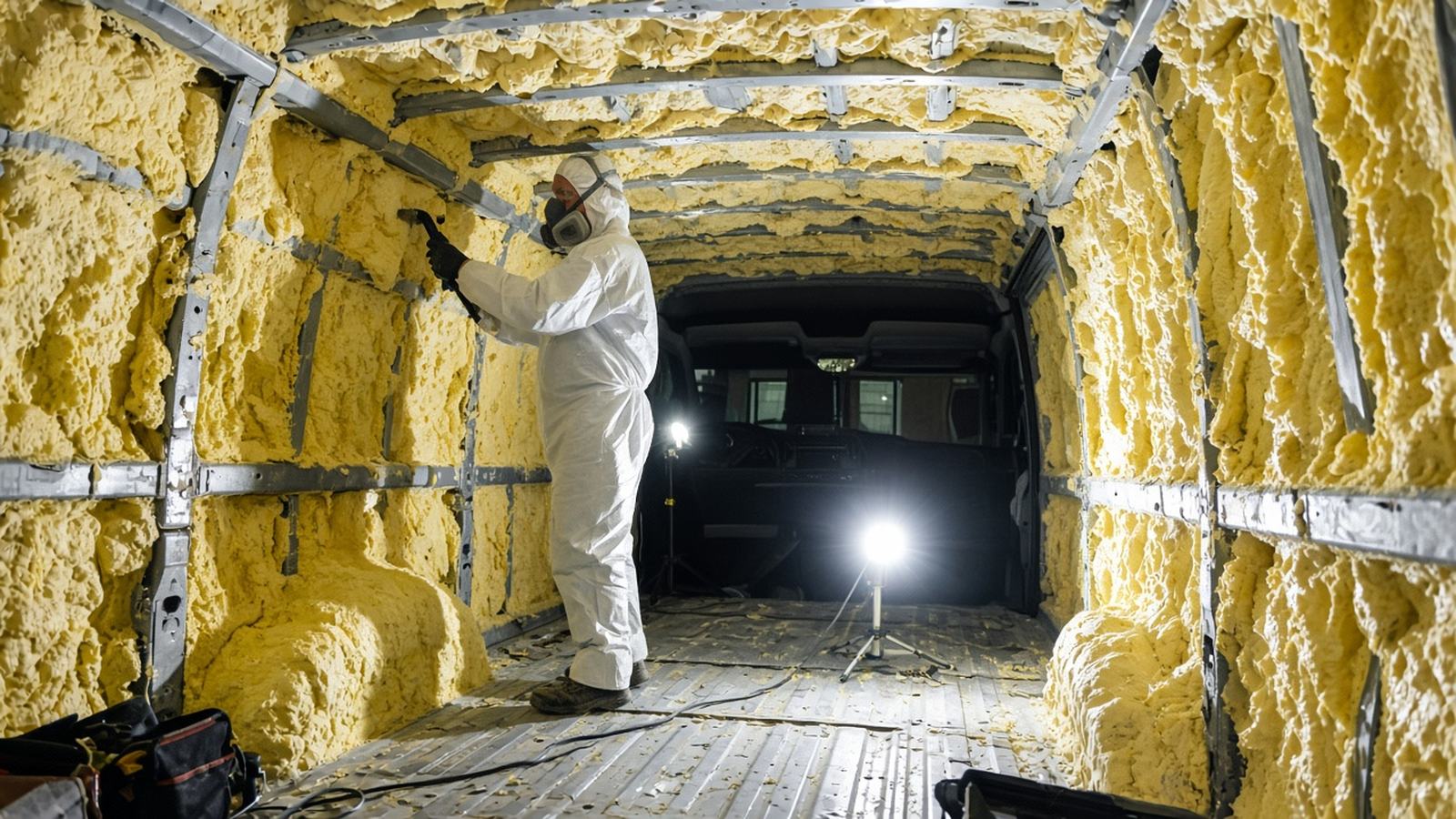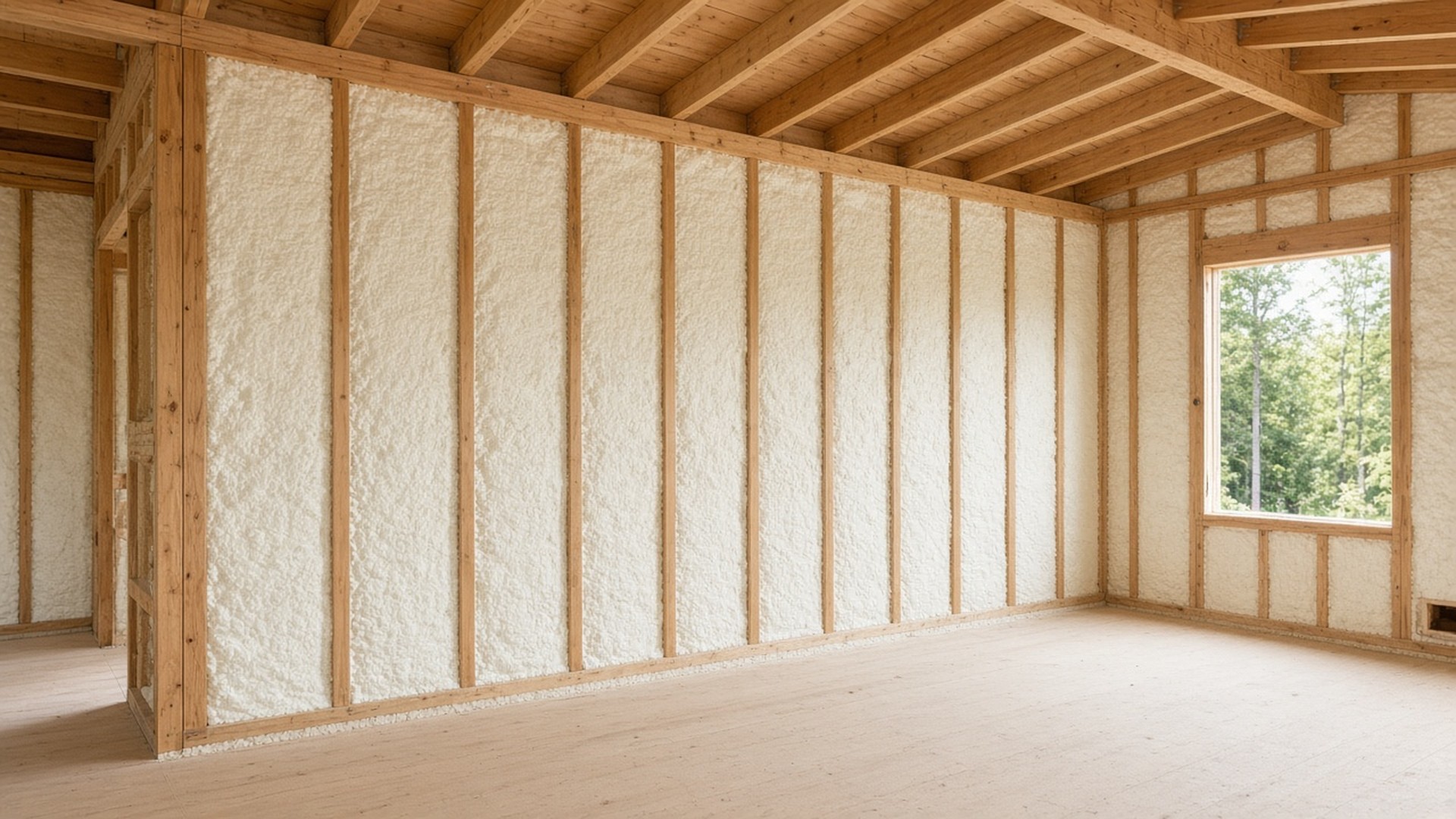
A bare cargo van is a steel box. It cooks in July, freezes in January and sweats on the inside every cold morning you sleep in it. Spray foam van insulation fixes all three better than anything else you can fit in the ribs, as long as you pick the right foam and spray it with some restraint. Get it wrong and you’ll have warped panels, foam in your door tracks or a wet layer of insulation behind your walls. This guide covers which foam to use, how much you’ll need and what it weighs, where not to spray, safety, and what it costs to do it yourself versus hiring a pro.
Why spray foam van insulation works
A van has three problems that batts and boards struggle with:
- Irregular cavities. Ribs, hat channels and curved roof bows leave odd-shaped gaps. Foam fills them completely.
- Air leaks. Every seam and factory hole moves air. Foam seals as it insulates.
- Condensation. Warm, moist air from your breath and cooking hits cold steel and turns into water. If that water forms behind the insulation, you’ve built a rust and mold factory.
The third one decides which foam to use.
Closed-cell vs open-cell in a van
The U.S. Department of Energy’s Building America program published a guide to spray foam insulation with typical properties for both types:
| Property | Closed-cell SPF | Open-cell SPF |
|---|---|---|
| Density | About 2.0 lb per cubic foot | About 0.5 lb per cubic foot |
| R-value per inch (aged) | About R-6.1 | About R-3.6 |
| Vapor behavior | Vapor retarder at typical thickness | Not a vapor retarder; 5 to 10 perms at 5 inches |
| Water | Doesn’t absorb much | Absorbs and holds liquid water |
| Feel | Rigid, adds stiffness | Soft, easy to compress |
Look at that table with a van in mind and the answer jumps out. Closed-cell is the right foam. It sticks right to the steel, so your breath and your coffee steam never touch the cold skin. You get close to double the R per inch, and when the ribs are an inch or two deep, that’s a big deal. Bonus: the panels stop booming like a drum at 70 mph.
Open-cell costs less and does fine in a house wall with real vapor control. In a van, though, it acts like a sponge pressed against bare steel. We cover where it does belong in open-cell spray foam: where it belongs. Our closed-cell spray foam guide goes deeper on the material itself.
How much foam and what it weighs
Foam’s priced and sold in board feet (a square foot, an inch thick). Grab a tape, add up roof, walls and doors, decide how thick, and plug it in. The calculator also spits out weight, using DOE’s density figures.
Van spray foam estimator
Two caveats on those numbers. DIY kits rarely deliver their full nominal yield, especially in cold weather or when you’re spraying short bursts, so leave room for waste. And the R-value is only what’s between the ribs. Every bare steel rib is a thermal bridge, so the wall as a whole performs worse than the foam alone.
Where to spray and where not to
Plan the van before you open a kit. The mistakes that hurt are almost always about spraying somewhere you shouldn’t have.
Spray:
- The roof skin between bows.
- The wall panels between ribs.
- The inside of the rear and side doors, if you’ll still have access to the latches and linkage.
- The wheel wells, if you’re not planning to cover them with a box.
Don’t spray, or mask first:
- Sliding door tracks and hinges. Foam in a track is a miserable fix.
- Drain holes at the bottom of the walls and doors. Water needs a way out.
- Wiring, harnesses and connectors you might need later. Run conduit or pull string first.
- Mounting points for seats, cabinets, solar brackets or rivet nuts. Mark them and tape over them.
- Window and fan cutouts. Cut and frame openings before you foam.
Go thin. Closed-cell foam gets hot as it cures, and a thick pass on a thin panel can distort the steel. Build up in thin passes, give each one time to cool, and don’t try to fill a deep cavity all at once. You’ll trim the excess flush with the ribs later anyway.
Safety and curing
Spray foam is made from two parts, an isocyanate side and a resin side, that react as they mix. While it’s spraying and curing, that’s a real exposure hazard. We break down the risks in is spray foam insulation safe, but for a van the basics are:
- Use a properly fitted respirator rated for the product, as the kit maker specifies, plus eye protection, gloves and covered skin.
- Ventilate hard. A van is a small, closed space. Open every door and run a fan that exhausts outside.
- Keep everyone else, and pets, away until the cure time on the label has passed.
- Don’t sleep in the van until it’s fully cured and aired out.
You will get foam on your skin at some point. This guide on how to get spray foam off hands is worth reading before you start, not after.
DIY vs professional cost
DIY. Two-component kits are sold by nominal board feet. Our roundup of the best spray foam kits for DIY compares current options. Add PPE, masking supplies and trimming tools. The upside is control. The downside is a learning curve on a project with no undo button. If you do make a mess, our guide to spray foam insulation removal covers cleanup.
Professional. A spray foam contractor with a rig gets better yield, a more even pass and faster work. Many will do vans, especially shops that already work on trailers and trucks. Ask how they handle masking and thin-pass application on sheet metal before you book. For a sense of how pros price foam generally, see our spray foam insulation cost guide.
Either way, the money question is usually smaller than people expect. A typical van uses a few hundred board feet. The bigger costs are your time and fixing mistakes, which is why prep matters more than price.
Common van foam mistakes
These are the ones we hear about most from people who did it once and learned the hard way:
- Spraying cold. Kits and the van skin both need to be in the temperature range on the label. A cold panel gives poor adhesion and low yield.
- Chasing depth. Trying to fill a three-inch roof cavity in one pass overheats the foam and can bow the roof.
- Forgetting the floor. Spraying the floor pan is usually a bad idea because it covers drain paths and makes subfloor mounting harder. Most builders use rigid board under a plywood subfloor.
- Skipping the wipe-down. Foam won’t bond well to dusty, oily or rusty steel. Clean and treat any surface rust first.
After the foam: trimming and finishing
Once the foam has cured:
- Trim it flush with the ribs using a long blade or a saw.
- Clean up the dust. Closed-cell dust gets everywhere.
- Check your marked mounting points and clear any foam that crept over them.
- Add a thermal break on the exposed ribs if you want to reduce bridging, such as thin foam tape or furring strips.
- Install your wall and ceiling panels.
Building code isn’t enforced on a van the way it is in a house, but the reason codes require a thermal or ignition barrier over foam still applies. DOE notes that spray foam is classified as combustible. Covering it with finished panels is good practice.
For more on how the numbers stack up, see our spray foam R-value guide.
Spray foam van insulation checklist
☐ Closed-cell foam chosen
Not open-cell against bare steel.
☐ Area measured and kits estimated
Waste allowance added.
☐ Tracks, hinges and drain holes masked
Taped and checked.
☐ Wiring and conduit run
Pull string in place for later.
☐ Mounting points marked
Rivet nut and bracket locations taped.
☐ PPE and ventilation ready
Respirator, eye protection, gloves, fan.
☐ Thin passes planned
Time between passes to let each one cool.
☐ Cure time respected
Nobody sleeps in the van until it’s cured and aired out.
Spray foam van insulation FAQ
Is closed-cell or open-cell foam better for a van?
Closed-cell, hands down. At normal thickness it works as a vapor retarder, so the damp air inside never meets cold steel. You also get roughly R-6.1 an inch, against R-3.6 for open-cell.
How much does spray foam add to a van’s weight?
Less than you’d guess. Closed-cell runs about 2 pounds per cubic foot. Spray 220 square feet at an inch and a half and you’ve got around 330 board feet, or roughly 55 pounds.
Can spray foam warp van panels?
Yep, if you lay it on thick in one go. The foam heats up as it cures. Go thin, wait, go again.
Is spray foam in a van safe?
The risky window is while you’re spraying and while it cures. Gear up the way the kit maker says, keep air moving, and don’t hang out in there until it’s done.
Will spray foam stop condensation in a van?
On the steel it covers, yes. The bare ribs and any metal you skipped will still sweat on cold mornings, so keep a roof fan or cracked window in the plan.
Free · No obligation
Get spray foam quotes from a local pro
Tell us what you want insulated and where. We’ll connect you with a qualified spray foam contractor near you.

Diana Mills is the founder and editor of Foam Insulation Review. With over 15 years of experience in the building materials and spray foam industry, she has tested hundreds of products, interviewed leading contractors, and published in-depth guides for homeowners and professionals alike. Diana is passionate about helping people make smarter insulation decisions.