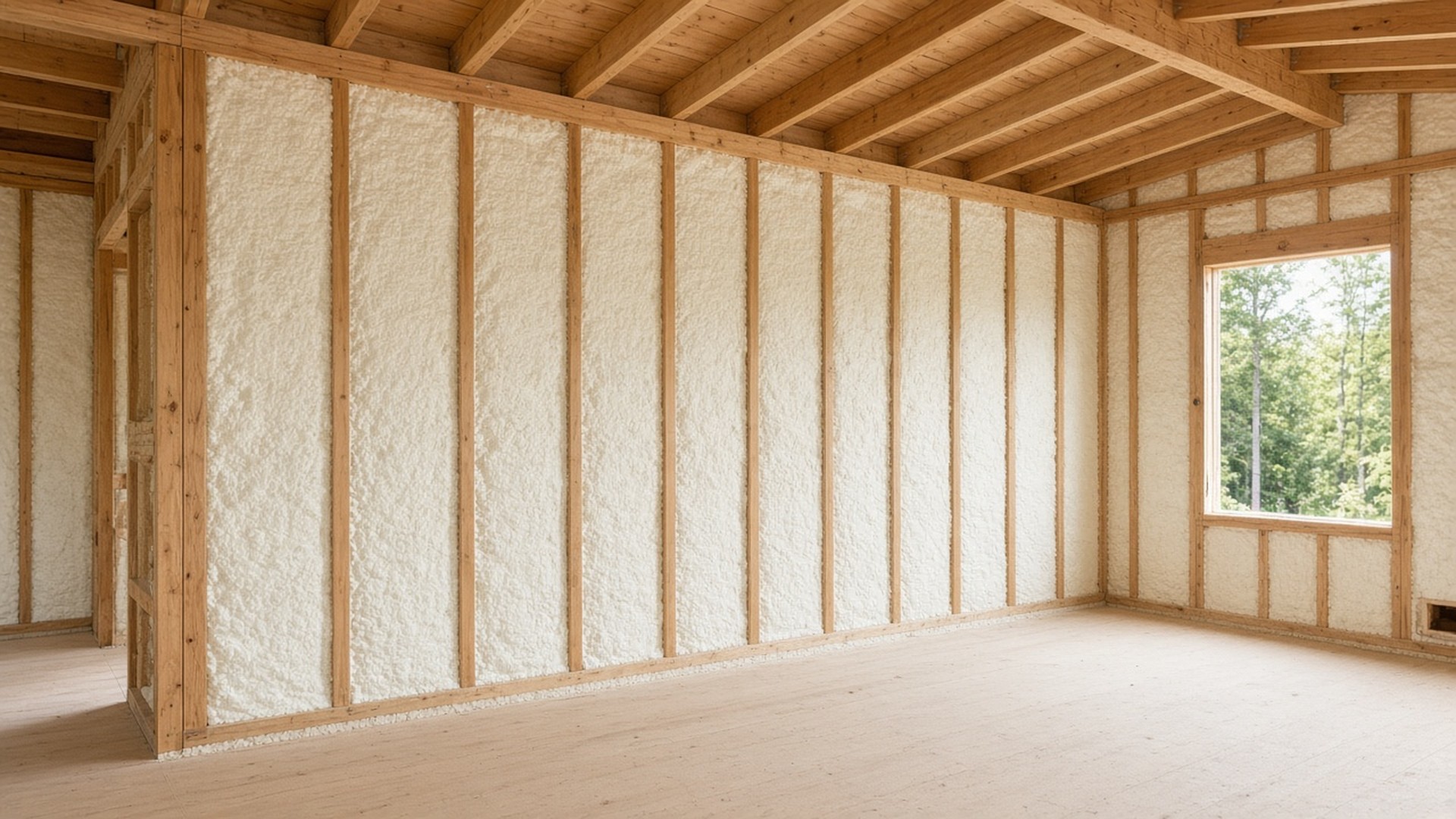
Open-cell spray foam has a reputation problem in both directions. Some homeowners hear “spray foam” and assume all of it is the same rigid, waterproof material. Others hear that open-cell “holds water” and rule it out entirely. The reality is more useful: open-cell foam is a very good product for some parts of a house and a poor one for others.
This review guide explains how open-cell foam behaves, where it belongs, where it does not, and what to look for when reviewing an installed job.
What makes foam “open-cell”
Spray polyurethane foam is created when two liquid components are mixed and sprayed, expanding into a foam. In open-cell foam, the tiny cells are not fully closed, so air fills the spaces in the material. That gives it several characteristics:
- Low density. It is soft and spongy compared with closed-cell foam.
- High expansion. It expands substantially as it sprays, filling cavities and irregular gaps.
- Air sealing. At adequate thickness, it stops air leakage very effectively.
- Vapor open. It allows water vapor to pass through more readily than closed-cell foam.
- Lower R-value per inch than closed-cell foam, so more thickness is needed for the same thermal performance.
Where open-cell foam belongs
Above-grade walls
In wood-framed walls, open-cell foam fills the cavity around wires, pipes and odd framing, sealing air leaks that batt insulation leaves behind. Whether an additional vapor retarder is required depends on climate zone and local code.
Unvented attic roof decks
Open-cell foam is often sprayed on the underside of the roof deck to create an unvented, conditioned attic. This brings ductwork and equipment inside the thermal envelope. Code requirements for this assembly vary by climate, and some colder zones require a vapor retarder or a specific foam type. Ask the installer how their design meets local code.
Interior walls and floors for sound
Open-cell foam reduces airborne noise transfer through gaps, which helps between rooms. It is not a complete soundproofing system on its own, but it is a common choice for interior partitions.
Where open-cell foam does not belong
- Below grade or in contact with liquid water. Open-cell foam can absorb liquid water. Basement walls in contact with soil, crawl spaces with flooding risk and areas exposed to bulk water are better suited to closed-cell foam or other systems.
- As a vapor retarder in cold climates without a design. Because it is vapor open, open-cell foam alone may allow moisture to reach cold sheathing in some assemblies. Climate-appropriate design matters.
- Where structural stiffness is wanted. Closed-cell foam can add some rigidity to assemblies. Open-cell does not.
- Exterior or exposed applications. Roofing and exterior foam systems use closed-cell foam with protective coatings, not open-cell.
Open-cell vs closed-cell at a glance
| Factor | Open-cell | Closed-cell |
|---|---|---|
| Density | Low, soft | Higher, rigid |
| R-value per inch | Lower | Higher |
| Vapor permeability | Vapor open | Low permeability at typical thickness |
| Liquid water | Can absorb | Resists |
| Typical uses | Walls, roof decks, interior sound | Basements, crawl spaces, roofing, flood-prone areas |
How to review an open-cell job
Whether you are a homeowner checking work or writing a review, here is what to look for.
- Coverage and continuity. The foam should be continuous, with no gaps at top plates, around windows, at rim joists or around penetrations.
- Thickness. Ask what thickness was specified and spot-check with a probe or ruler.
- Adhesion. Foam should be bonded to the framing and sheathing, not pulled away at the edges.
- Trimming. In walls, excess foam is trimmed flush with studs. Over-trimming can reduce thickness.
- Odor. A temporary odor during and after installation is common, but a lasting strong odor can indicate a problem with mixing or application and should be raised with the installer.
- Ignition and thermal barriers. Exposed foam in living spaces and many attics requires a code-approved thermal or ignition barrier. Ask how this was handled.
- Ventilation and HVAC. A tighter house may need mechanical ventilation. Ask whether the HVAC contractor was involved.
Questions to ask before the job
A good installer welcomes questions. Ask which foam product will be used and request its data sheet. Ask what thickness is planned for each area and how it will be verified. Ask how long occupants should stay out of the house during and after spraying, and what ventilation will be running. Ask about the thermal or ignition barrier plan for each space, and whether the attic will become conditioned space. Finally, ask how the installer handles areas that are hard to reach, such as top plates, rim joists and corners behind ductwork, because that is where gaps are most often found later.
Writing a useful review
The most helpful reviews describe the house, the climate and the assembly, not just the crew’s punctuality. Note where the foam was used, whether it was open- or closed-cell, the thickness, how comfort and energy bills changed over a full season, and how the installer handled questions about code and ventilation. If the job could go either way, ArmorThane’s comparison of open-cell vs closed-cell spray foam lays out R-value, vapor control and cost.
Related reading: Closed Cell Spray Foam: Where It Pays Off, Where It Does Not and What to Check
Frequently asked questions
Is open-cell foam waterproof?
No. It is an air barrier, not a water barrier. It should not be used where it will be in regular contact with liquid water.
Does open-cell foam hide roof leaks?
Because water can move through or be absorbed by open-cell foam, a roof leak may show up differently than with fiberglass. Regular roof inspections remain important.
Is open-cell foam cheaper than closed-cell?
It is usually less expensive per inch, but it takes more thickness for the same R-value. Compare quotes based on the full specified assembly.
Free · No obligation
Get spray foam quotes from a local pro
Tell us what you want insulated and where. We’ll connect you with a qualified spray foam contractor near you.

Diana Mills is the founder and editor of Foam Insulation Review. With over 15 years of experience in the building materials and spray foam industry, she has tested hundreds of products, interviewed leading contractors, and published in-depth guides for homeowners and professionals alike. Diana is passionate about helping people make smarter insulation decisions.