Last updated: June 14, 2026 | Reviewed by Robert Kowalski, SPFA Certified Professional
R-value is the single most important number when it comes to evaluating insulation performance — and yet it’s also one of the most misunderstood metrics in the building industry. When homeowners and contractors ask us about spray foam R-value, the conversation inevitably gets complicated fast.
In this guide, we’ll explain exactly what R-value means, how open-cell and closed-cell spray foam compare, why R-value alone doesn’t tell the whole story, and how to determine what R-value you actually need for your specific project and climate zone.
Quick Reference: Spray Foam R-Values
| Foam Type | R-Value Per Inch | Typical Installed Thickness | Total R-Value |
|---|---|---|---|
| Open-Cell SPF | R-3.7 to R-3.9 | 3.5″ – 5.5″ (walls) | R-13 to R-22 |
| Closed-Cell SPF (2 lb.) | R-6.5 to R-7.0 | 2″ – 4″ (walls) | R-13 to R-28 |
| Closed-Cell SPF (1.5 lb.) | R-5.5 to R-6.0 | 2″ – 3.5″ | R-11 to R-21 |
What Is R-Value and Why Does It Matter?
R-value measures thermal resistance — specifically, a material’s resistance to conductive heat flow. The “R” stands for “resistance,” and the higher the number, the better the material resists heat transfer. A wall insulated to R-21 will lose heat roughly twice as slowly as one insulated to R-10, all else being equal.
R-value is additive: if you layer two R-10 materials together, you get R-20. This is why some builders stack rigid foam board over spray foam to achieve very high R-values in compact spaces.
Open-Cell Spray Foam R-Value
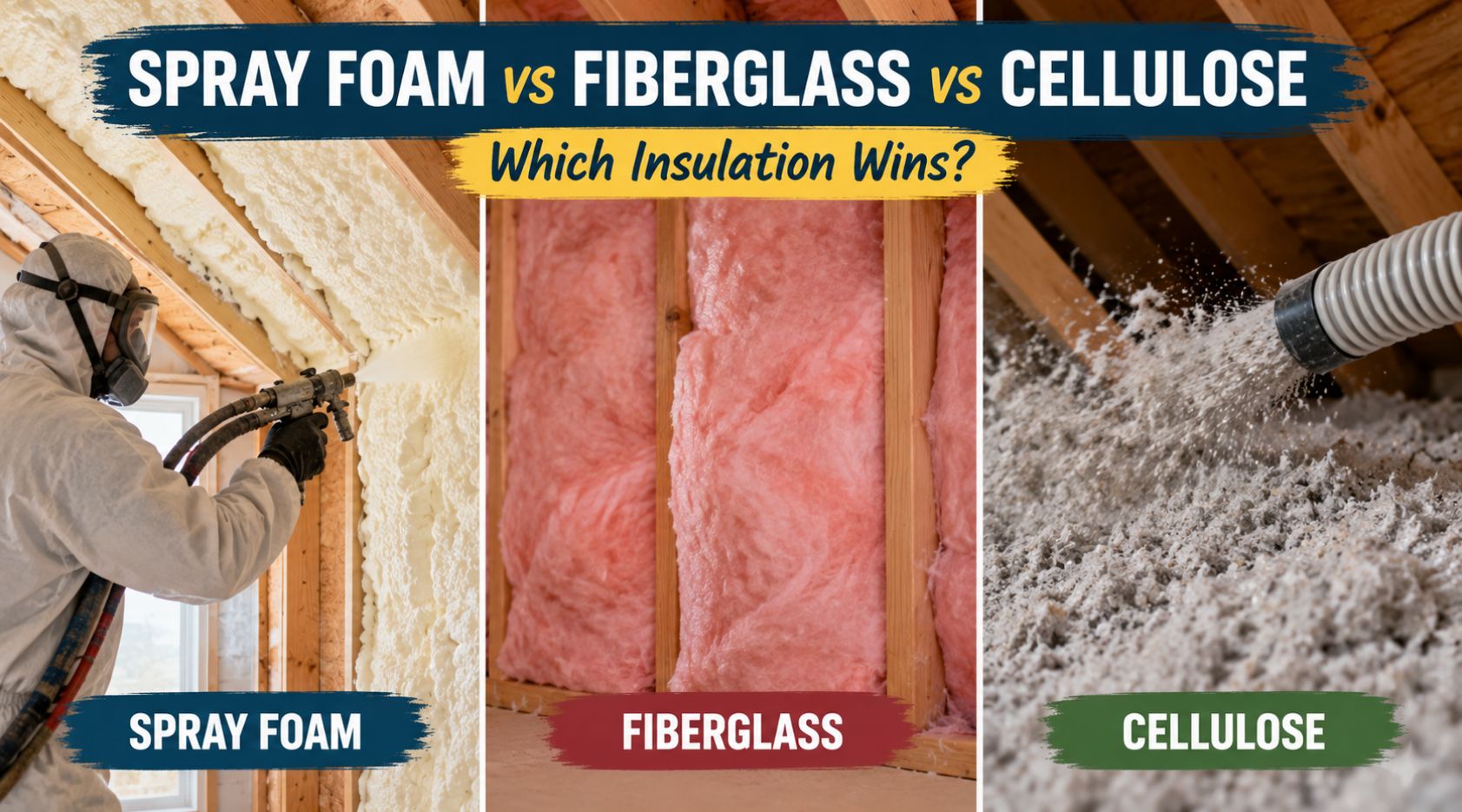
Open-cell spray foam (also called 0.5 lb. density foam) achieves approximately R-3.7 to R-3.9 per inch when properly installed and cured. This is only slightly better than fiberglass batts (R-3.1 to R-3.4 per inch) or blown cellulose (R-3.2 to R-3.8 per inch).
So why use open-cell foam if its R-value per inch is similar to cheaper alternatives? The answer lies in what R-value doesn’t measure: air sealing. Open-cell foam, even at relatively thin applications, creates an exceptional air barrier. Research by the Building Science Corporation shows that a continuous air barrier can improve a building’s thermal performance by 30-40% beyond what R-value alone predicts.
Closed-Cell Spray Foam R-Value
Closed-cell spray foam (2 lb. density) is the highest R-value insulation material available for field-applied use, achieving R-6.5 to R-7.0 per inch. This makes it possible to achieve significant R-values in very thin assemblies — critical for retrofits where you can’t lose wall thickness.
For example, a 2-inch application of 2 lb. closed-cell foam achieves approximately R-13 — the minimum code requirement for walls in Climate Zones 1-4 — while only adding 2 inches to the wall assembly. An equivalent R-value with open-cell foam would require 3.5 inches; with fiberglass batts, 4 inches.
The Whole-Wall R-Value Factor
Here’s the critical concept most homeowners never hear about: “nominal” R-value (the R-value of just the insulation material) is very different from “whole-wall” R-value, which accounts for thermal bridging through structural framing members.
In a standard 2×4 wall framed at 16″ on center, roughly 25% of the wall is wood framing. Framing has an R-value of only about R-1.25 per inch — dramatically lower than the insulation it interrupts. This means a wall filled with R-13 fiberglass batts has a whole-wall R-value closer to R-9.8.
Spray foam — especially closed-cell — applied to the interior face of the sheathing creates a continuous thermal break that eliminates most thermal bridging. This is why 3 inches of closed-cell foam (nominal R-21) can outperform R-38 batt insulation in real-world energy performance.
What R-Value Do You Need?
R-value requirements depend on your climate zone (as defined by the International Energy Conservation Code), the part of the building being insulated, and whether you’re building new or retrofitting. Here are the 2021 IECC requirements for walls:
| IECC Climate Zone | States Included | Min. Wall R-Value (cavity) | Min. Attic R-Value |
|---|---|---|---|
| Zone 1 (Hot) | South FL, HI | R-13 | R-30 |
| Zone 2 (Hot-Humid) | Most of FL, TX Gulf, LA | R-13 | R-38 |
| Zone 3 (Warm) | Most of TX, GA, AL, CA coast | R-13 + R-5 ci | R-38 |
| Zone 4 (Mixed) | Most of VA, NC, KS, NM | R-13 + R-5 ci | R-49 |
| Zone 5 (Cold) | Most of OH, IN, PA, WA | R-20 or R-13 + R-5 ci | R-49 |
| Zone 6 (Very Cold) | MN, MT, northern ME | R-20 + R-5 ci | R-49 |
| Zones 7-8 (Subarctic/Arctic) | Northern AK | R-21 + R-10 ci | R-49 to R-60 |
Is Spray Foam Worth the Extra Cost for R-Value?
The honest answer: it depends on what you’re comparing and why you’re insulating. Spray foam costs 2-3x more per square foot than fiberglass batts to install. On a per-R-value basis, it’s more expensive. But the total-performance picture often favors spray foam when you factor in:
- Air sealing performance (spray foam eliminates the need for a separate air barrier installation)
- Moisture vapor control (closed-cell foam acts as a Class II vapor retarder)
- Structural rigidity (closed-cell foam adds racking strength to wall assemblies)
- Longevity (spray foam R-value doesn’t degrade over time like fiberglass or cellulose)
- Application in difficult geometries (under-stair spaces, rim joists, irregular framing)
For more on costs and when spray foam makes the most financial sense, see our guide on Counting the Cost: What to Know About Closed Cell Spray Foam. To understand all your insulation options, visit our Resources & Downloads page for the complete comparison guide.
Key Takeaways
- Open-cell spray foam achieves approximately R-3.7 to R-3.9 per inch; closed-cell (2 lb.) achieves R-6.5 to R-7.0 per inch
- R-value alone doesn’t capture spray foam’s full performance advantage — air sealing and vapor control matter enormously
- Whole-wall R-value (accounting for thermal bridging through framing) is a more accurate real-world performance metric than nominal R-value
- Minimum R-value requirements vary by climate zone — know your zone before specifying insulation
- Spray foam typically costs more per R-value unit than fiberglass but often outperforms it on total building energy use
Have questions about R-value for your specific project? Post them in our Community Forum and get answers from certified professionals. You can also contact our team directly.
Free · No obligation
Get spray foam quotes from a local pro
Tell us what you want insulated and where. We’ll connect you with a qualified spray foam contractor near you.

Diana Mills is the founder and editor of Foam Insulation Review. With over 15 years of experience in the building materials and spray foam industry, she has tested hundreds of products, interviewed leading contractors, and published in-depth guides for homeowners and professionals alike. Diana is passionate about helping people make smarter insulation decisions.